How to Start a Business at 50 Without Hustle Culture
How to start a business at 50 without hustle culture: a five step method built for real energy, real money, and the…
Read This Essay →Business Strategy
The energy drop is real, but the bigger change is tolerance. What I changed in my business after 50, and how to tell fatigue from a business that's wrong.
10 min read
In 2024, my husband Rick and I drove 17,000 kilometers, from Alberta down to the Guatemala border and back, with our dog Fozzie in the back seat.
Somewhere in a plaza in Mazatlán, my watch buzzed.
I looked down. A client.
So I pulled out my phone to find out what was wrong. Nothing was wrong. It could have waited a week, and probably two. I put the phone back in my pocket and stood there in the sun, in the middle of the trip I’d built an entire business to be able to take, doing the exact thing that business had made it impossible to stop doing.
I’d bought that watch on purpose. I wanted clients to be able to reach me.
The energy drop is real. Mine started with recovery time. I’d have a full day, and where I used to bounce back overnight, I didn’t. Then the motivation went. Things I’d wanted to do for years sat there and I couldn’t make myself care about them.
But the energy is the part everyone talks about, and it’s the smaller half of the story.
What changed was my tolerance. Things I had absorbed for fifteen years without noticing became unbearable. Client emails I used to answer cheerfully now arrived with a sense of dread attached. The notification on my wrist, which I’d installed deliberately and had been perfectly fine with for years, started to feel like being poked.
Nothing about my business had changed. Same clients. Same expectations. Same work I’d been doing happily since 2008. What changed was my willingness to keep absorbing it.
That distinction is the whole thing, and it took me a long time to see it.
Low energy tells you nothing useful. It just tells you that you’re tired, and the only responses available are to push through or do less.
A drop in tolerance tells you something specific. It tells you which parts of your business were costing you the whole time, back when you had enough surplus to pay for them without noticing. The surplus is what’s gone. The cost was always there.
Because almost all of it is written for someone with a different body and a different life.
Be everywhere. Post daily. Make Reels, and make them on all three platforms, and make them this week, then batch a month of short-form video on a Sunday.
I have thirty years of experience and a set of things I genuinely know. There is no version of a fifteen-second vertical video that carries any of it. The format cannot hold what I have to say, and the volume it demands is exactly what my tolerance can no longer pay for.
So you follow the advice, it costs more than it returns, you get more tired, and the conclusion on offer is that you didn’t want it badly enough.
You wanted it. The advice was written for someone else.
None of this is philosophy. These are the actual rules, including the unimpressive ones.
I got rid of the Galaxy Watch, because the notifications were the problem and there was no setting that fixed it. I replaced it with a Fitbit that has no notifications on it at all.
I’m not convinced I even need that one. It may go too.
I still have legacy Geek in Your Pocket clients, and I still look after them. But there’s a block on my calendar every week, and anything that isn’t genuinely time-sensitive goes there.
The work didn’t reduce. The interruption did, and the interruption was what I was actually paying for.
I work by email or by voice message, usually Voxer. If something looks like it needs a live conversation, I ask by voice first, and most of the time the answer is that it doesn’t.
When it genuinely needs more, I record a video and we talk that way, on our own hours.
I deliver in audio and written material rather than video. It’s not that I can’t do video. It’s that video is expensive for me in a way that doesn’t show up on anyone’s spreadsheet, and after I’ve made one I’ve got nothing left for the rest of the day.
Building the business around what’s cheap for me to produce was one of the highest-return decisions I’ve made.
I send email most days, and email is the one thing in my business that isn’t negotiable.
But I write it once a week, in one sitting. The daily thing my readers experience is not a daily thing I do.
I schedule a couple of hours in the morning and a couple in the afternoon. That’s it. Four or five hours on a working day.
Before that, I have a slow morning on purpose. Rick leaves for work between 7:30am and 8:00am, and from then until around half past nine or ten I journal, sit, and read. That’s not what’s left over after the work. It’s booked first.
Usually it starts with bad sleep. And about once a quarter, because I’m hypothyroid, I get a day where the energy is simply not there. Not low. Absent.
Here’s what I do, which is less noble than it sounds.
I open my calendar and I hand the day to my AI team. They tell me what genuinely has to happen today and move everything that doesn’t.
Most of the time the answer is that nothing is critical. And then I give myself permission to stop.
Here’s the surprise. Those are often the days I get ideas. They go in a paper notebook in my pocket, and I look at them again when I’m capable of judging them.
The next day, if the energy is back and there’s more of it than I planned for, I take advantage and do more. The flexibility only works in both directions. A business that lets you do less on a bad day but can’t absorb a good one is only half-built.
Tools. Project managers, task managers, apps with boards and swimlanes and automations. I tried a lot of them, and every one added a layer of maintenance I then had to have the energy to maintain. The system for managing the work became work.
What I use now is Obsidian, which is essentially a folder of plain text files, plus AI that can read it. I have a conversation and things get found, sorted, written down and picked back up. Bringing AI in is the single change that made low days survivable, because on a day when I can talk but I can’t organize, talking is enough.
Pushing through. This one took longer to give up on, because it had worked for about twenty years. It stops working, and the recovery cost after is larger than whatever you gained.
Waiting for my energy to come back. Mine hasn’t, and I’ve stopped expecting it to. That sounds bleaker than it is, because what replaces it is better information about what you actually want to spend yourself on.
This is the question underneath all of it, and there’s a reasonable test.
Ask what specifically you dread. The particular piece of it, rather than the work as a whole.
If you dread all of it evenly, you’re probably tired and you need rest before you need decisions.
But if it’s sharp and specific, if it’s the notifications, or the calls, or one particular client, or the video, then that’s not fatigue. That’s your tolerance handing you a list. And the list is accurate, because it’s built from years of data your surplus energy used to hide from you.
I read my list and it said: the interruptions, the obligation to be instantly available, and answering to a lot of people at once. So I built something without them in it.
That’s what the Q.U.I.E.T Method™ came out of, and it’s why I now work with women who are trying to do the same thing: build the business around the life and the body they’ve actually got, rather than the ones the advice assumes.
Yes, and it’s worth separating the two things it might be. A general flatness across everything usually points to energy, sleep, or something medical worth getting checked. Motivation that’s dropped only for specific parts of your work is different, and it’s usually telling you those parts were costing you more than you realized.
You can, but the business has to be built for it rather than adapted to it later. In practice that means as little time-sensitive work as you can manage, asynchronous communication by default, and delivery formats that are cheap for you to produce. The goal is that a bad day costs you nothing except that day.
No. It’s one option among several and it happens to be the loudest one. I’ve built my business on email and written work, and I don’t make short-form video at all. Pick the format you can produce consistently on an average day, because consistency is what compounds, and a format that drains you won’t be consistent.
For me it’s four to five, in two blocks. That’s not a rule for anyone else. What matters more than the number is that the hours are decided in advance rather than expanding to fill whatever’s left.
Wait for a week that isn’t a bad one, and work out the specific pieces first. Sometimes the fix is a rule rather than an exit. My own answer eventually was to leave a business that paid me well, but it took a year on the road to be sure, and the certainty came from evidence rather than a mood.
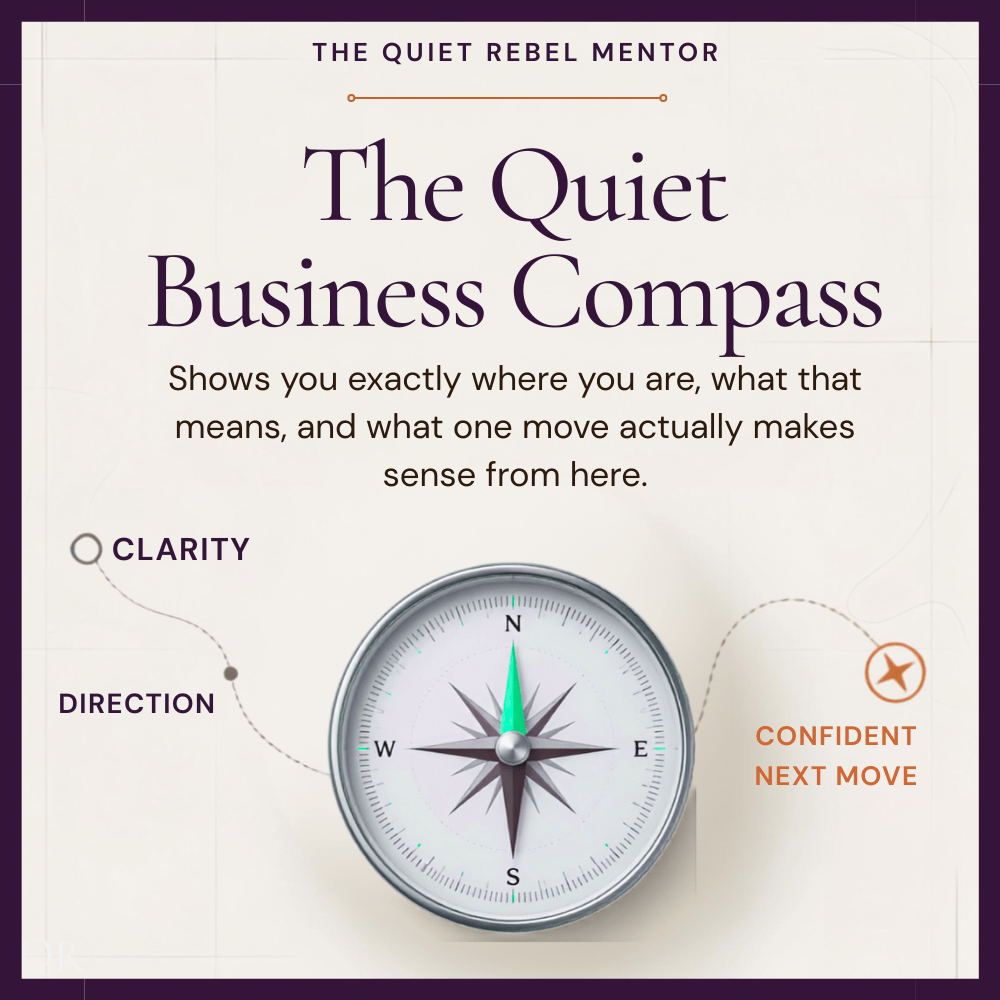
If you recognize yourself here, the useful first move is to work out which stage you’re actually at, because the advice that’s right for someone building their first offer is wrong for someone unwinding a business that works.
I made a free five-question diagnostic for exactly this. It takes a few minutes and it tells you which stage you’re in and what to do next in that stage.
And if you want more on the energy question specifically…
Build quietly, rebel loudly.
It’s your business, your energy and your rules.
Keep reading