Running a Business After 50 When Your Energy Isn’t What It Was
The energy drop is real, but the bigger change is tolerance. What I changed in my business after 50, and how to…
Read This Essay →Business Strategy
How to start a business at 50 without hustle culture: a five step method built for real energy, real money, and the life you already have.
10 min read
I quit my job in 2008 with no plan.
What I had was a ninety minute commute each way, three hours of my day spent on a crowded bus, then Skytrain, and a husband who’d built his working life around what he actually wanted. Rick wasn’t smarter than me. He’d stopped waiting for permission, and I hadn’t.
So I handed in my notice. Then I sat in my house and realized I had no idea what I was going to do.
The way to start a business at 50 without hustle culture is to build it around your real capacity first, and choose the work second. Most advice runs that backwards. It picks an exciting idea, then asks you to find fourteen hours a week you don’t have to feed it.
What follows is the order I use now, after seventeen years, one business that paid well, and a pile of offers that didn’t sell.
No, and the research points the other way. The mean founder age for the fastest growing 1 in 1,000 new ventures is 45.0, from a study of US Census Bureau records by Pierre Azoulay, Benjamin Jones, Daniel Kim and Javier Miranda. Their words: successful entrepreneurs are middle-aged, not young.
The same paper found something that matters just as much, and arguably more than the headline age.
Prior experience in the specific industry predicts much greater rates of entrepreneurial success. The thirty years you’ve been told are “too broad” and “not a niche” are the asset the data keeps finding. (source)
So lateness is the wrong thing to be worrying about.
The question “am I too old” is usually about something else entirely: every model you’ve been handed assumes a runway and a tolerance for wasted years that you no longer have.
Hustle advice fails after 50 because it’s priced in a currency you no longer have: surplus energy.
A twenty-eight year old can throw a year at an experiment and absorb the loss. You’re working with a smaller margin, and the advice never accounts for it.
Three mismatches show up again and again.
The recovery gap. Push hard for a week at thirty and you sleep it off. Push hard for a week at fifty-five and you’re paying for it the following week too. I wrote about how that reshaped my whole operation in what changed in my business when my energy changed.
The runway gap. “Give it eighteen months and see” is reasonable when you have four decades of working life left. It’s an expensive sentence when you’re building something you want to still be running at seventy.
The visibility gap. Daily video and daily posting assume performance is free. For most of the women I talk to it’s the most draining part of the model, and it’s the part sold hardest.
The answer is to build against a real constraint instead of an imaginary one.
Write down the number of genuinely good working hours you have in a week, then design only what fits inside it.
Use the hours you actually have on an ordinary week, with the life already in it, rather than the ones you could theoretically claw back.
For me that number is around fifteen. Two blocks a day, four or five hours in total. Anything that doesn’t fit inside that gets cut or redesigned, however good it sounds.
This one move does most of the work. It rules out the membership that needs weekly live calls. It rules out the content model that needs you on camera every day.
And it turns “what should I build” from an infinite question into a short list. Constraints make your options countable.
The Q.U.I.E.T Method™ is the order I work in now. Five steps, and the order matters more than any one of them.
Stop the things costing you before you add anything new. Most women I talk to are already at capacity, so step one is subtraction. The client who drains you. The offer you’ve propped up for a year.
I know how backwards that feels when you’re trying to start something. You have no surplus to build with until you make some.
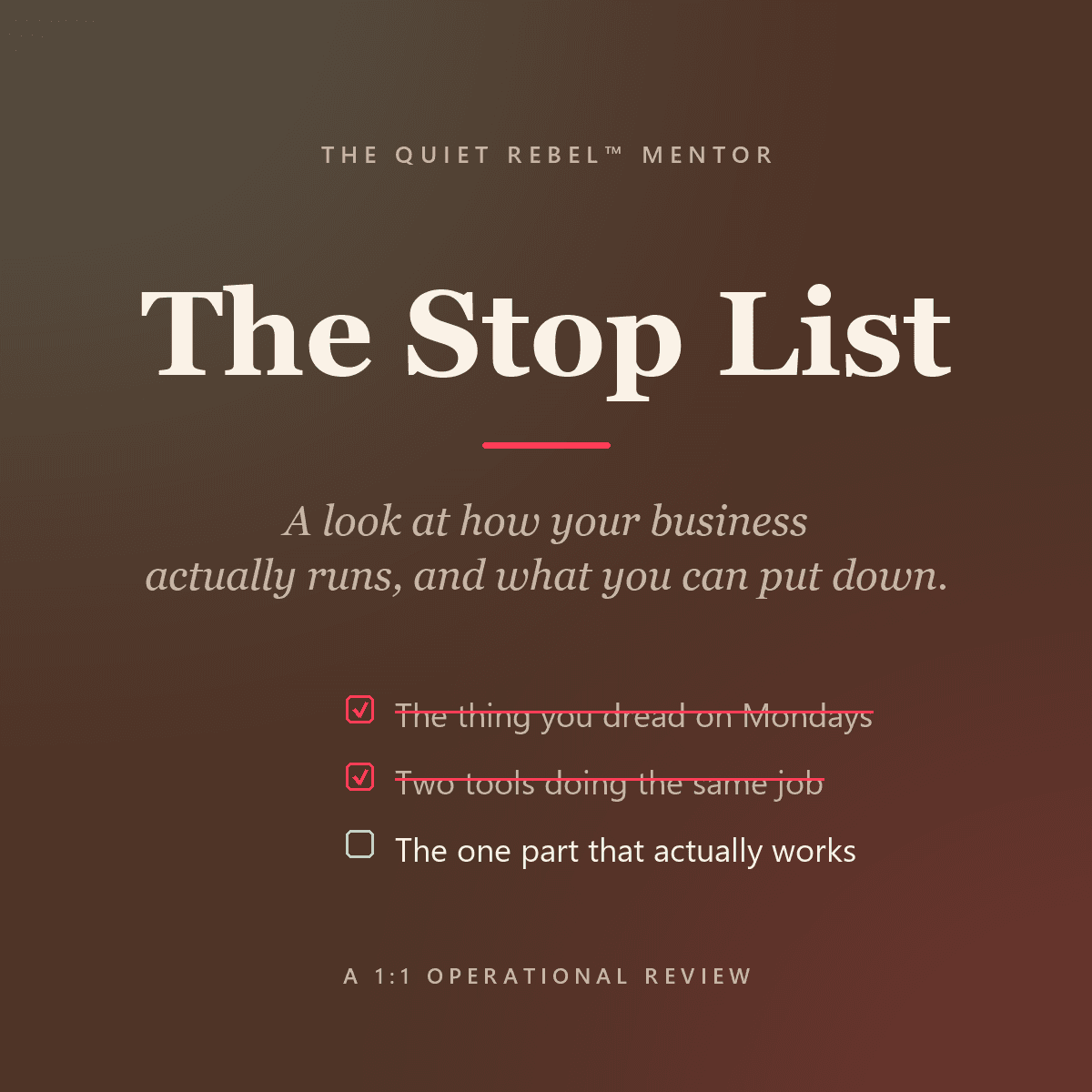
The Stop List is a 1:1 review of what you’re actually running. You send an intake and a short screen recording, I send back a map of your setup, what to stop, and what to do instead. $197 for the first three, then $297.
Work out what you already have, before you go looking for something new to learn. Thirty years of work leaves evidence: the problems people bring you, the thing you fix without noticing, the skill you assume everybody has.
Mine turned up in a networking conversation, not a course. Someone described a technical problem and I answered it without thinking. She said “you should charge for that.” That sentence built the next fifteen years.
Decide what the business is for in your actual life, in plain numbers. How much money, and by when. Whether it survives a bad month with you in bed.
Vague intentions produce vague businesses. “I want it to replace my income” is a decision. “I want to see where it goes” is a hobby with paperwork.
Build the smallest complete version and put it in front of real people. One offer, and one way to pay for it. Everything else can wait.
Everything I’ve built that worked started embarrassingly small. Everything that failed started polished.
Keep what earns and let the rest go, on a schedule, so it lands on the calendar rather than on a mood. I review what’s running every quarter. Anything that isn’t paying its way in money or genuine enjoyment gets retired.
Want to go deeper with this idea? The fuller version of the framework lives on the Q.U.I.E.T Method page.
| The hustle model | The energy-first model | |
|---|---|---|
| Starts with | An exciting idea | Your real weekly capacity |
| Assumes | Surplus energy, a long runway | A smaller, more accurate margin |
| Growth comes from | Volume: more posts, more launches | Retention: fewer things, kept longer |
| Visibility | Daily performance on someone else’s platform | A list you own, at a pace you set |
| A bad month | Breaks the model | The model was built for it |
| Typical failure | Burnout at month nine | A slow start you can survive |
I’ve run both. The first paid well and nearly cost me the reason I started.
The business that worked was boring and recurring. After the tech aptitude turned up I went technical VA, then a WordPress design boutique, then Geek in Your Pocket, which was website maintenance and support on a monthly subscription.
No launches. No funnels for years. It grew to a comfortable full-time income and stayed there, and I wound it down at the start of 2026 on my own terms.
Here’s the part hustle culture gets right and I got wrong. In 2024 Rick and I drove 17,000 kilometers, from Alberta down to the Guatemala border and back, with our dog Fozzie in the back seat. I’d built the business specifically so that trip was possible. I still answered client messages from a plaza in Mazatlán.
A business can pay well and still be the wrong one. Building it around a constraint I’d never written down is how I ended up there.
My list sits at around 2,100 people and opens at better than 40%. That took years rather than a launch. I’ve also run a ten-day launch that sold precisely nothing, and I published the numbers: what a launch with zero sales actually taught me.
Ninety days is enough to prove a direction and too short to bet your savings on it. Here’s the sequence I’d give you if you were sitting across from me.
If ten people won’t buy it from you personally, a sales page won’t fix that. If they will, you’ve got something worth building infrastructure around.
What you’re testing is whether the work is wanted, at a size that can’t hurt you. Most first-year advice tests something else entirely, which is whether you can survive the marketing.
Is 50 too late to start a business?
No. Research on high-growth startups puts the mean founder age at 45, and it found prior industry experience strongly predicts success. Starting later means starting with more evidence about what you’re good at and what you’ll tolerate.
How many hours a week do you need to start a business at 50?
Fewer than you’ve been told, if you design for it. I run mine on roughly fifteen good hours a week. The number matters less than picking a model that fits it, because a business designed for forty hours will fail at fifteen.
What’s the best business to start at 50 without hustle culture?
One built on what you already know, sold to people who already have the problem, with recurring or repeat revenue rather than launches. Mine was website maintenance on a monthly subscription. Boring, steady, and it paid for seventeen years.
How do I start over at 50 after caregiving?
Start with capacity rather than ambition. After years of pouring into other people, the hard part is rarely the business skills. It’s finishing the sentence “I want.” Give that its own time before you pick a business model.
How long before a business started at 50 makes money?
Longer than the launch stories suggest and sooner than nothing. Selling by hand to ten people can produce money inside ninety days. Replacing an income usually takes years, and building at a pace you can hold is what gets you there.
The missing piece is usually stage, rather than ideas. You need to know which of them you’re at, because advice that helps someone at stage four will actively hurt someone at stage one. That’s the mechanism behind most of the contradictory advice you’ve been drowning in, and I’ve written about it in why good advice lands wrong at the wrong stage.
There are four stages, and the free diagnostic below will tell you which one you’re standing in right now.
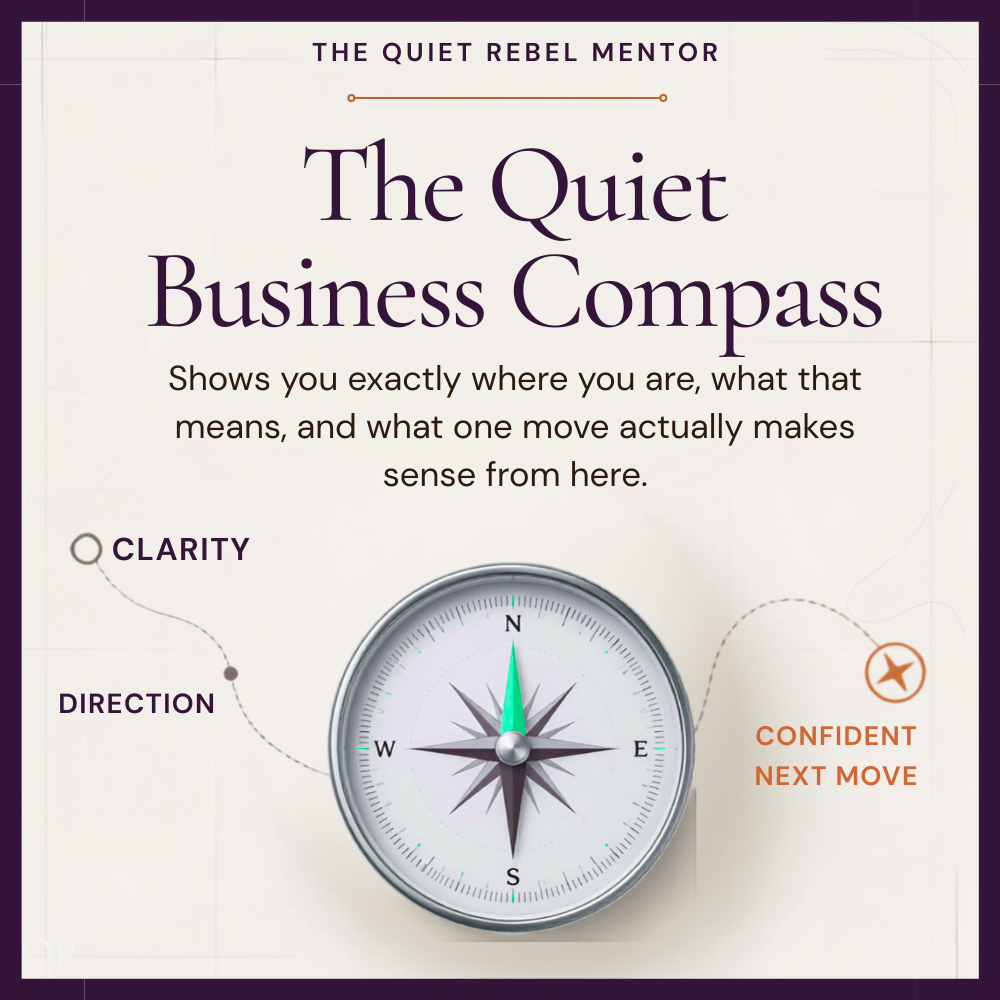
The Quiet Business Compass is a five-question diagnostic that tells you which of four stages you’re in, and what actually matters there. Free, about two minutes.
Build quietly, rebel loudly.
It’s your business, your energy and your rules.
Keep reading